Causes
It’s hard to define a tumour cell in absolute terms, because other than an abnormal proliferation, there very little difference between a tumour cell and a normal cell. One way to define tumour cells from normal cells is that they differ from normal cells in their lack of response to normal growth control mechanisms. There are usually many different factors influencing this mechanism, as some altered cell may still respond to one signal but not to another. A further complication is that some tumour cells don’t even proliferate (divide).
Because of all these, tumours have been classified into three main groups according to their appearance and behaviour:
- Benign tumours- they can arise from any tissue, and grow locally. These tumours cause damage by, growing in mass, producing local pressure or obstruction. One of their features is that they don’t spread.
- Pre-malignant tumour- has the morphological appearance of cancer cells (as they show various degree of dysplasia), develops in epithelium, and is usually small (in comparison to other tumours). These tumours also don’t spread.
- Malignant tumours (full-blown cancers)- cancers have the ability to invade and destroy their neighbouring cells and tissue (local invasion). As said tumours needs nutrients, so they produce a range of proteins, which can stimulate the growth of new blood vessels, enabling them to continuously grow.
- Damage to these new vessels can cause malignant tumour cells to enter lymphatic or blood vessels and travel to other organs in the body (metastasis).
Molecular basis of Cancer/tumour
Several kinds of genes have shown to contribute to the development of cancers. Cell proliferations and cell growth are regulated by two sets of opposing functioning genes. They are called:
1. Proto-oncogenes- they are growth promoting gene
2. Tumour-suppressing genes- they negatively regulate cell-cycle
Oncogenes are dominant mutation, whereas tumour suppressor genes are recessive mutations.
There are several kinds of proto-oncogenes in the DNA and they code for proteins which are involved in the regulation of cell growth and differention. Damage to the proto-oncogene (which changes the gene to oncogene) is caused for example by a point mutation or viral genome insertion mutation into that gene, causing a loss of function mutation. This lost-of-function mutation in turn allows the cell to divide out of control.
Tumour suppressor genes encode proteins which prevents the formation/growth of tumours. Lost of one tumour suppressor gene doesn’t cause (or only causes a partial) formation of tumours, because there is usually another allele. Tumour formation requires both alleles to be damaged (‘two-hit hypothesis). Inactivation of both increases the cells susceptibility to tumour formation.
P53
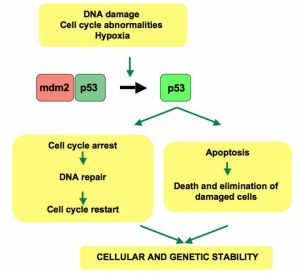
p53 is an transcription factor that is encoded in the TP53 gene, which is a tumour suppressor gene. It was found through p53 knock-out mice, that lack of p53 protein increased the cells susceptibility to tumour formation. p53 protein recognizes damage to damage in cells and respond by inhibiting cell proliferation by arresting cell cycle, and induce apoptosis
|
Image created by Thierry Soussi is of courtesy of Wiki Commons under creative commons license: https://773909fb0b.cbaul-cdnwnd.com/a5263d5eae320f0b698f8792e823a592/200000010-969c197959/P53_pathways.jpg |