Introduction
Tumours in the Central nervous system (CNS) are rare, but they have steadily been increasing the last three decades and now average between 4500-5000 of new CNS cancers diagnosis annually in UK (~8 per 100,000 population), in the US there is an average of 44,000 new cases annually (which is ~14.8 per 100,000 population). While brain tumours account for less than 2% of all primary tumours they are responsible for 7% of life lost from cancer before age 70. Brain tumors may be classified in several different ways, World Health Organization published in 1993, a classification of neoplasm’s affecting the central nervous system.
A tumour is a swelling or lesion formed by an aberrant proliferation of cells in a tissues / organs (called Neoplasia). There are different tumour variant ranging from potentially harmless to lethal; called Benign, premalignant, malignant tumour, but they can also be called primary or secondary tumours depending on the location, e.g. whether it formed on that location or did it get there from a different position within the body.
Tumours can occur at any stage in your life, no matter the age. But generally the incidence of cancer/tumour will increase as you grow older. Males have slightly incidence for tumours of the CNS than females in the UK, but in US is actually the opposite. Overall though, around 25% of all tumors in those aged 0–14 years and 9% in those aged 15 to 24 years involve the CNS. They are the most common cause of cancer-related deaths in this age. In adults aged 25–84 years the proportion of CNS tumors is 2%. 5 year overall survival is 10–15% and there is considerable morbidity in survivors.
|
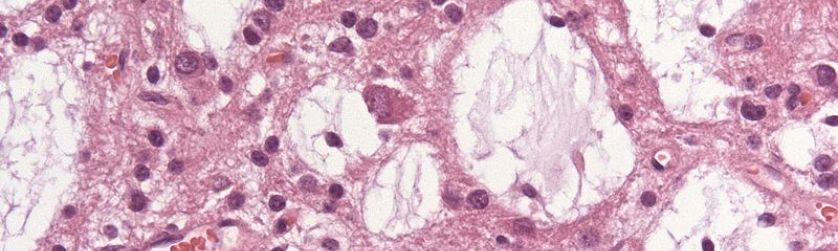
Banner courtesy of Wiki Commons under creative commons license: https://commons.wikimedia.org/wiki/File:DNET_HE.jpg |